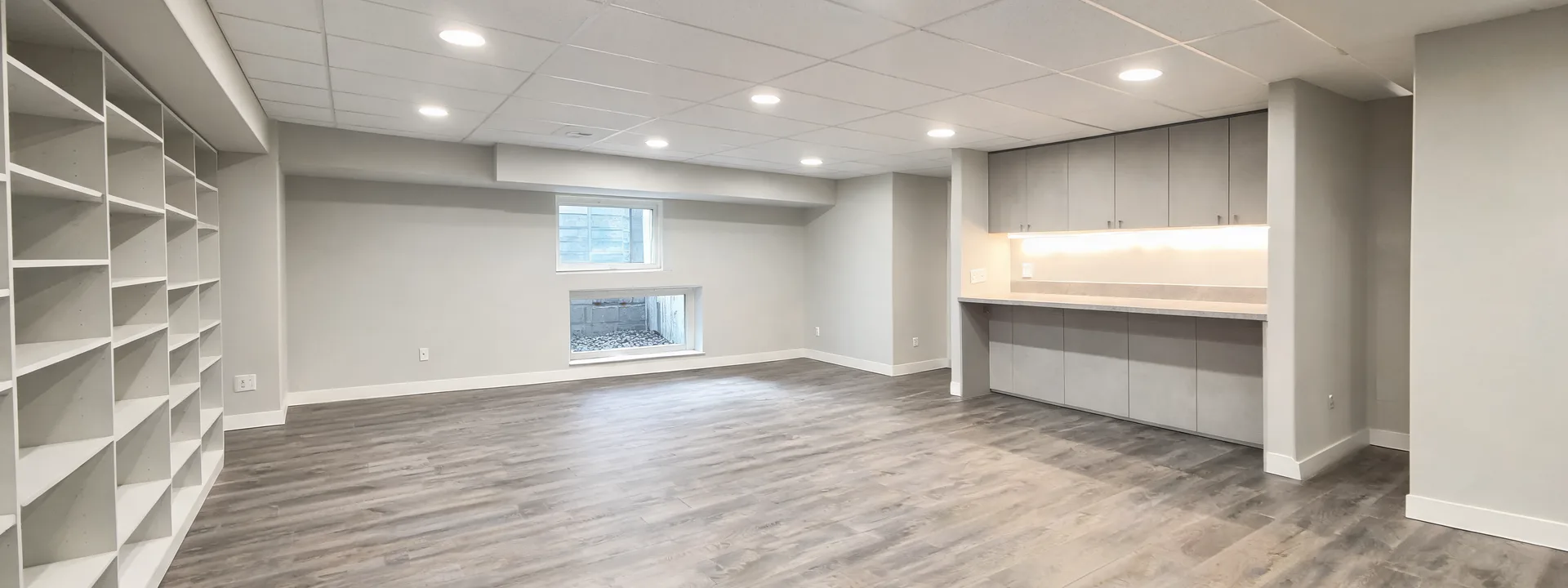
What Can Your Basement Become?
Most Nassau County homes built between 1940 and 1990 have full unfinished basements. That’s typically 800–1,200 square feet of space that’s being used for storage — or not at all.
Finishing that basement turns it into livable area at a cost per square foot that’s consistently lower than an above-grade room addition, because the foundation and subfloor are already there.
Here’s what we build in Nassau County basements:
Family Room and Entertainment Space
Open-plan family rooms are the most requested basement finish. We remove load-bearing posts where possible (using engineered beams as replacements), create a dedicated media area, and add proper egress lighting and electrical for a safe, comfortable space.
Home Office
A dedicated basement home office is increasingly popular. We insulate and soundproof the space from the floor above, run separate electrical circuits for equipment, design task lighting that doesn’t rely on natural light, and create an environment that works for focused work.
Guest Suite
A basement guest suite with a full bathroom gives visiting family members their own space. The key requirement: an egress window well that meets code. Every bedroom (and any room being used as a sleeping space) in a basement must have a code-compliant egress window in Nassau County.
Gym or Fitness Room
Rubber flooring, utility sink, mirrored walls, and proper electrical for equipment. Soundproofing from the floor above is recommended.
Playroom
Child-friendly basement finishes with washable flooring, built-in storage, and safety-focused lighting. We plan these to be reconfigurable as kids age.
Rental Apartment (with proper permits)
A finished basement can become a legal accessory unit if it meets Nassau County’s requirements for ceiling height, egress, separate entrance, full kitchen, and full bathroom. This is essentially a mother-daughter unit at the basement level. We handle the special use permit process if you want to pursue this option. See our mother-daughter extensions page for details.
Nassau County Code Requirements for Finished Basements
Egress Windows
Any room used as a sleeping area in a basement must have a code-compliant egress window — minimum clear opening of 5.7 square feet, minimum clear height of 24 inches, minimum clear width of 20 inches, no more than 44 inches from the floor to the sill. The window well must be large enough to allow emergency exit.
We assess your existing basement windows during the initial visit. Most Nassau County homes will need at least one egress window upgrade if you’re planning a bedroom or guest suite.
Ceiling Height
Nassau County building departments require a minimum ceiling height of 7 feet (measured to the bottom of any beams or ductwork) for finished habitable basement space. Some older homes have 6’8” or 6’9” basements — we evaluate this before design begins.
Electrical
Finished basements need updated electrical: proper circuit capacity, GFCI protection near any wet areas, smoke detectors, and carbon monoxide detectors if there’s a gas appliance. We bring in licensed electricians familiar with Nassau County code.
Building Permit
All finished basement work in Nassau County requires a building permit. The permit process includes plan review, rough inspection, insulation inspection, and final inspection. We handle all of it.
Waterproofing and Moisture Considerations
Nassau County soil is clay-heavy, which means drainage is poor and water intrusion is common in older basements. Before we put up walls and flooring, we assess the moisture situation.
If your basement has water infiltration — visible staining, efflorescence on the walls, musty odor — that needs to be addressed before finishing. Installing drywall over a wet foundation wall is a recipe for mold.
We don’t provide waterproofing ourselves, but we work with reputable waterproofing contractors and can coordinate that scope into the project timeline if needed.
For basements with minor moisture but no active water intrusion, we use moisture-resistant materials throughout: pressure-treated bottom plates, fiberglass or closed-cell spray foam insulation (never open-cell or fiberglass batts against foundation walls), moisture-resistant drywall, and LVP or tile flooring rather than hardwood or carpet.
Our Basement Finishing Process
Assessment: We visit your basement, measure the space, check ceiling heights, evaluate existing windows for egress compliance, assess moisture conditions, and review the electrical panel.
Design: We create a layout that maximizes the space given the constraints — beam locations, utility clearances, egress window requirements.
Permit Filing: Building permit filed with your building department. Basement finishing permits are typically reviewed faster than above-grade additions — often 2–4 weeks.
Construction: Framing, insulation, electrical rough-in, plumbing rough-in (for any wet bar or bathroom), drywall, flooring, lighting, trim, paint.
Final Inspection and CO: We schedule and attend all inspections.